
The transmission industry is no stranger to supply chain disruption. Over the past several years, project leaders have adapted to extended timelines for critical components including transformers, breakers, and conductors, often stretching 12 to 36 months.
But as utilities and EPCs begin to stabilize processes in the face of these realities, a less obvious risk is emerging – one that creates the physical pathway for projects to start: site access mat supply.
For projects already operating on tight schedules, this could be the next bottleneck that delays execution.
The Hidden Mat Dependency in Transmission Projects
Transmission expansion is accelerating. North America alone is expected to require roughly $100 billion in tra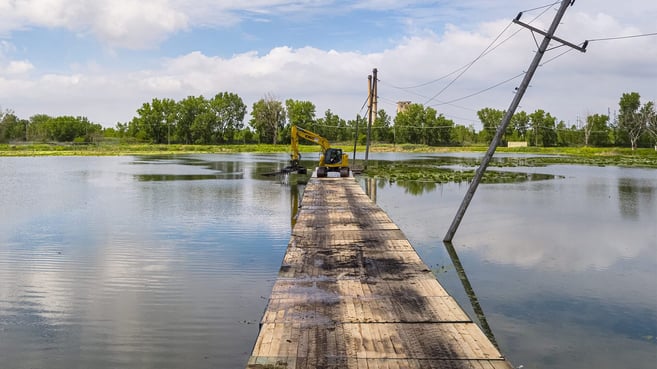 nsmission investment this decade.
At the same time, project complexity is increasing:
- Longer equipment lead times are compressing construction flexibility
- Climate-driven weather volatility is shrinking predictable work windows
- Environmental regulations are reshaping how, when and where projects can be mobilized
- Labor shortages are limiting predictable execution capacity
All of this creates a simple but critical reality: once construction starts, there is very little room for delay.
That’s where site access – specifically mat availability – becomes mission critical.
Why Your Mats Matter More Than Ever on the Job Site
Access mats [or ground protection mats] are often treated as a tactical, last-mile consideration; one that can be secured on-demand. But in today’s new working environment, they play a much larger role.
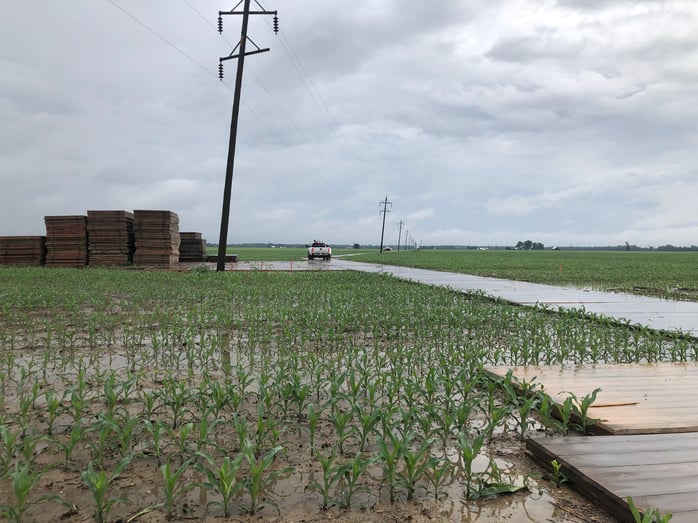
At their most essential effort, they determine whether crews can mobilize on schedule while protecting the terrain and ensuring compliance with local regulations and landowner requirements. Site access mats are critical to enabling work continuity during adverse weather and staying on track despite shifting site conditions.
Without them, heavy equipment can’t reach work areas and feet can’t safely stay on the ground. And when access is blocked, everything stops.
The challenge? Mat supply chains are tightening fast. Traditional timbers are becoming harder and harder to source while demand increases due to the major infrastructure investment, and concerns about the sustainability of composite mats can be a non-starter for some projects.
The Emerging Bottleneck: Mat Supply
Historically, access mats could be sourced on relatively short notice, often within days.
That’s no longer the case. Demand is increasing alongside transmission, renewable, and infrastructure buildouts, resulting in:
- Lead times expanding to 6+ months for larger projects
- Logistics constraints (freight costs, equipment availability) compounding delays
In addition, weather volatility is increasing demand for matting mid-project.
The same supply chain dynamics affecting transformers and cable are now moving downstream to site access materials. And for many projects, this risk is not fully accounted for in planning. In short, the road to access the work can no longer be taken for granted.
The Cost of Getting It Wrong in Access Planning and Procurement
 When mat supply is underestimated or delayed, the consequences cascade quickly:
- Schedule delays that jeopardize outage windows
- Emergency procurement costs at premium rates
- Access failures leading to damaged roads and sites
- Environmental non-compliance risks
- Strained landowner relationships
And in today’s environment, the risk is even greater. If mats aren’t available when needed, the project simply cannot move forward, impacting the next one and the one after that as well.
Why Supply Chain Control in Site Access Matting Is Becoming a Strategic Advantage
As supply uncertainty spreads across the project lifecycle, the winners will be the organizations that control, not just source, their critical inputs – and that now must include site access matting.
This is where access providers are beginning to differentiate.
Traditionally, many providers rely on third-party sourcing from sawmills or fragmented supply networks. That approach works in stable conditions but becomes a liability when capacity tightens.
Matting supplies that control the manufacturing process create predictability, allowing for certainty of outcome in availability, lead times, and an ability to shift on the fly when responding to project changes. And when mats are an engineered product, consistency in product quality and performance create the ability to truly keep projects on schedule.
TerraLam + Sterling Solutions: Built for This Moment

Sterling Solutions’ TerraLam access mats platform is designed to address exactly this challenge.
Unlike traditional mat suppliers, Sterling operates internally controlled manufacturing facilities, with geographic diversification across locations in Illinois and Texas. Additionally, our matting products deliver significant advantages to the user by being engineered.
TerraLam mats are 40% lighter than a traditional timber mat but offer the same performance. Yet, they are also double the length, meaning not only do users know exactly what they are getting every single time to build their paths but they are also doing it with less freight and less labor.
Sterling has built its matting model to deliver:
1. Supply Reliability
Internal production reduces dependency on strained and fragmented external suppliers, helping to ensure mats are available when projects need them.
2. Lead Time Stability
While others face extended sourcing timelines, integrated manufacturing allows for more predictable delivery windows.
3. Scalability
As project needs evolve, whether due to weather, terrain, or scope changes, capacity can scale more effectively.
4. Product Optimization
Control over manufacturing enables innovations like enhanced CLT mat durability, through our dipped and dowelled fleet, and engineered solutions that improve performance in demanding environments.
The Bottom Line: Site Access is No Longer a Commodity, It’s a Critical Path
The transmission industry has already seen how supply chain disruptions can derail projects.
What’s changing now is where that disruption shows up next.
Access mat supply is emerging as a new bottleneck – one that directly impacts whether projects can break ground, stay on schedule, and meet their objectives. Access, and the mats that enable it, must be treated as part of the critical path, with planning done in advance.
Learn more about how you can align your mat strategy with a supplier that can build your roadways more efficiently and reliably by connecting with one of our site access experts.